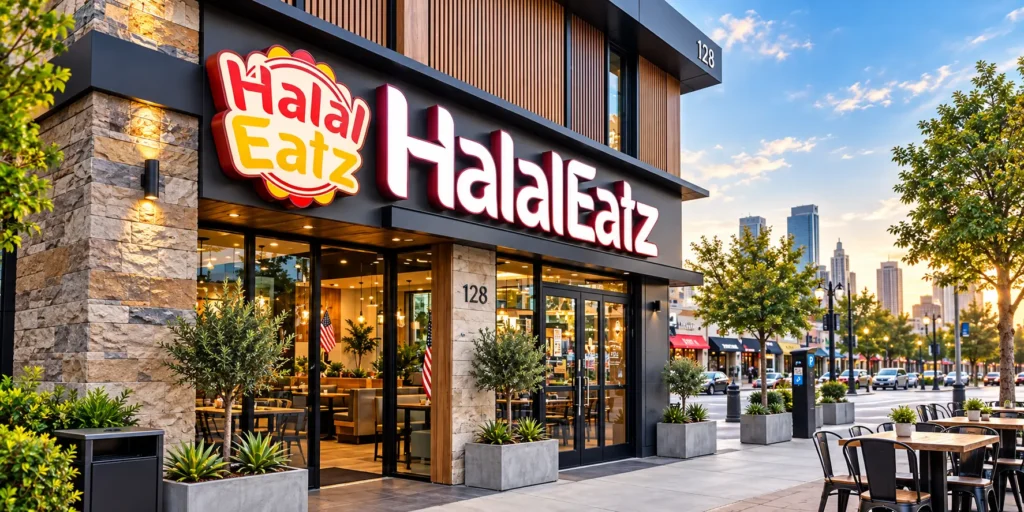
A strong storefront sign does more than display a business name. It helps customers notice the brand, understand what the business offers, and remember it later. For our recent USA project for Halal Eatz, we produced custom 3d signs for bussiness using illuminated acrylic-faced channel letters, deep maroon returns, internal LED modules, and a custom illuminated logo box.
This project is a good example of how a commercial sign moves from raw material and letter fabrication to LED fitting, electrical testing, and final illumination before shipment and installation.
The finished signage was designed for a food business, so it needed to be highly visible, colorful, easy to read, and strong enough for commercial exterior use.
Project Overview: Custom Halal Eatz Storefront Sign
The Halal Eatz project combined two different signage elements.
The first was a custom logo sign featuring the red and yellow Halal Eatz identity. The second was a set of individual 3D illuminated letters spelling out the business name.
The design used a combination of:
- White translucent acrylic faces
- Maroon/red letter sides
- Internal LED modules
- Custom-built 3D letter bodies
- Illuminated logo elements
- Electrical wiring and power connections
- Deep letter returns for stronger dimensional appearance
- Bright front illumination
- Commercial storefront construction
The purpose was to create signage that would remain visible in daylight but become especially prominent after dark.
Food businesses often depend heavily on roadside and storefront visibility, so the sign needed to work from several viewing angles and at different distances.
Step 1: Fabricating the 3D Acrylic-Faced Letters
The fabrication process begins with the shape of each individual letter.
For this project, the front faces were produced using white acrylic, while the side walls were formed in a deep maroon/red finish that matched the Halal Eatz branding.
Acrylic is frequently used for illuminated channel letters because it allows LED light to pass through the front surface while maintaining a clean appearance during the day.
The side walls, often called returns, create the depth that gives channel letters their 3D appearance.
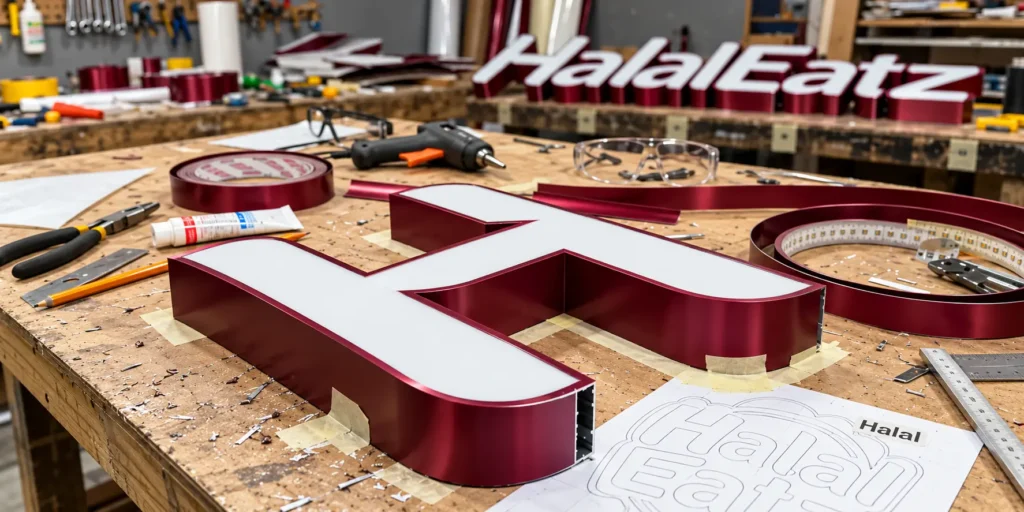
This stage requires much more precision than many customers realize.
The return must follow the letter shape accurately. Tight corners, curves, and narrow sections need careful bending so the finished character looks clean when viewed from both the front and the side.
The depth also provides enough internal space for lighting.
If a letter is too shallow, the LEDs can create visible hot spots through the acrylic. If it is too deep, the letter can look unnecessarily bulky.
The correct depth therefore needs to balance appearance, illumination, letter size, and viewing distance.
Why Acrylic Works Well for Illuminated Channel Letters
Acrylic is one of the most useful materials for commercial illuminated signage because it offers a combination of visual quality and light transmission.
For front-lit letters, the acrylic face performs several jobs at the same time.
It defines the visible shape of the character, protects the internal lighting system, and diffuses light from the LED modules installed behind it.
The thickness and color of the acrylic affect the final appearance.
White acrylic is particularly popular because it provides a bright, clean face when illuminated and remains highly visible during daylight.
For restaurant signage, this is useful because the sign should remain effective throughout the entire operating day.
The Halal Eatz design uses the white face against darker maroon side walls, creating strong contrast even before the lighting is switched on.
Step 2: Installing LED Modules Inside the Letters
Once the channel letter bodies are fabricated, the lighting stage begins.
The acrylic face alone does not create the illuminated effect. LED modules are installed inside the hollow letter body to produce even front illumination.
The positioning of these modules is critical.
If LEDs are installed too far apart, dark areas can appear on the face. If they are positioned too close together, the sign can become unnecessarily bright and consume more power than required.
Each letter shape also behaves differently.
A wide letter may require more modules than a narrow character. Curved letters may need modules placed around the perimeter and center to create balanced lighting.
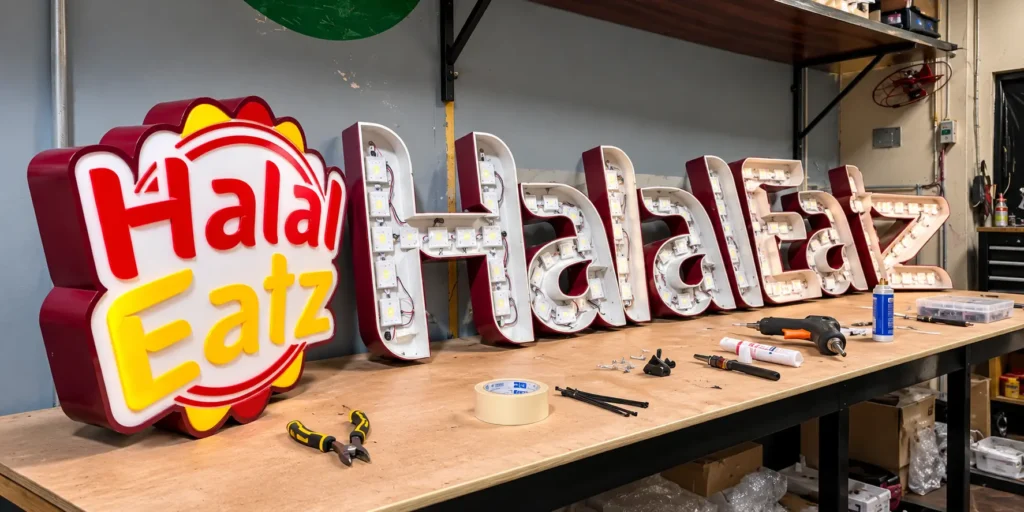
This photograph is particularly useful because it shows what customers normally never see after installation.
Inside each character are multiple LED modules, wiring connections, mounting points, and the structural body of the letter.
When the acrylic front is finally fitted, all of this internal work becomes hidden.
That is why the quality of a channel letter cannot be judged only by looking at the exterior.
Good 3d signs for bussiness depend heavily on what is happening inside the letter.
LED Layout and Even Illumination
One of the biggest differences between professional and low-quality illuminated signage is the uniformity of the light.
A professionally illuminated letter should appear smooth from edge to edge.
Customers should not see individual LED dots through the face.
To achieve this, the fabricator needs to consider:
- LED module spacing
- Distance between LEDs and acrylic
- Letter depth
- Acrylic opacity
- Internal reflection
- Stroke width
- Corners and curves
- Electrical load
During fabrication, the LEDs are normally tested before the acrylic face is permanently closed.
This gives the production team an opportunity to identify dim spots or uneven lighting.
For this project, the letters were illuminated during the workshop testing stage so brightness and consistency could be checked before packing.
Step 3: Building the Custom Halal Eatz Logo
The logo required a different fabrication approach because it contains multiple colors and shapes rather than simple individual letters.
The red “Halal” text, yellow “Eatz” text, white illuminated background, and surrounding decorative shape all needed to work together as one recognizable brand element.
This type of custom logo signage is more complicated than producing a standard alphabet character.
Every colored section needs the correct proportion, depth, illumination, and alignment.
The finished logo creates an immediate visual connection with the brand.
Customers do not need to read every word from a distance; the color combination and overall shape can become recognizable on their own.
That is particularly valuable for restaurants and food businesses where customers may repeatedly pass the location by car.
Why 3d signs for bussiness Are More Visible Than Flat Boards
Flat printed boards still have a place in commercial signage, but three-dimensional illuminated letters provide a very different level of visual impact.
The depth creates shadow and dimension during daylight.
At night, the LEDs turn the lettering into an active light source.
That means the same sign produces two different visual experiences.
During the day, customers notice the physical materials, colors, letter depth, and branding.
At night, the illuminated acrylic faces become the primary feature.
This extended visibility is one of the reasons restaurants, convenience stores, retail shops, salons, pharmacies, jewelry stores, and service businesses frequently use channel letters.
A well-designed sign continues advertising the business after daylight disappears.
Step 4: Wiring and Power Management
Lighting a set of individual channel letters requires more than connecting every LED to a single cable.
The electrical load has to be calculated and distributed correctly.
Power supplies must be selected according to the total LED consumption and installation conditions.
Good wiring also makes future maintenance easier.
During production, the wiring system should be organized so connections remain accessible and protected.
Exterior signs require additional consideration because the system may be exposed to heat, moisture, dust, and changing weather conditions.
For commercial signage, we focus on details such as:
- Properly rated LED modules
- Correct power-supply capacity
- Secure wire connections
- Organized cable routing
- Suitable electrical protection
- Access for future maintenance
- Testing before dispatch
Electrical work at the final installation site should also comply with local building and electrical requirements.
Step 5: Glow Testing Before Shipment
The final workshop stage is one of the most important.
Before the signage is packed, the letters are illuminated and inspected.
This is where the production team checks the real nighttime effect.
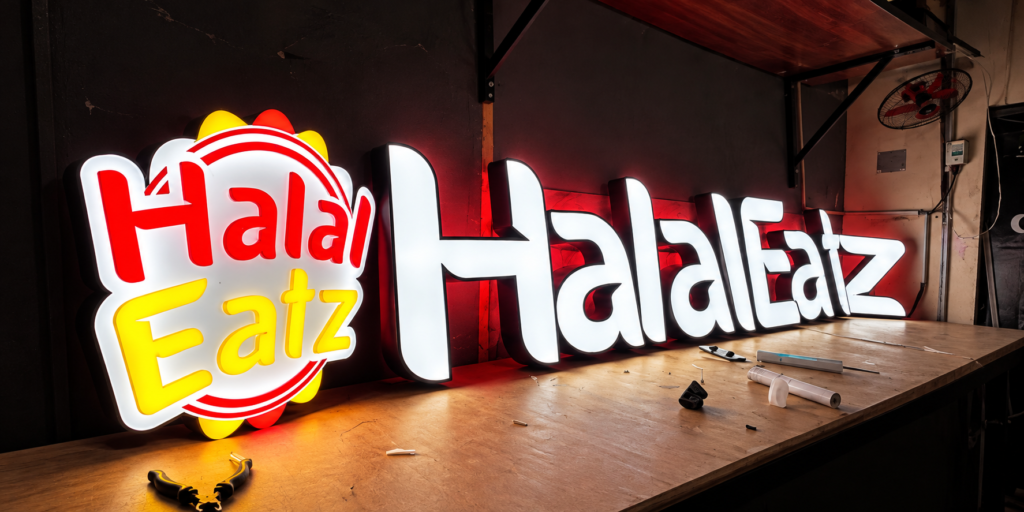
Glow testing allows several details to be checked at once.
The team can confirm that all characters illuminate correctly, that the brightness is consistent, and that there are no unexpected shadows across the acrylic.
The color relationship also becomes much clearer at this stage.
For Halal Eatz, the illuminated white faces create strong contrast with the maroon side walls, while the logo uses red, yellow, and white lighting to retain the original brand identity.
Seeing the complete set illuminated also helps verify that the lettering works as one coordinated storefront system rather than as individual components.
Daytime Appearance vs. Nighttime Appearance
A successful commercial sign should look professional whether the LEDs are on or off.
During daylight, the viewer primarily sees the physical materials.
The shape, thickness, color, spacing, and finish all become important.
At night, illumination becomes dominant.
This means a signage design should never depend entirely on LEDs to look attractive.
The Halal Eatz letters maintain strong visibility during the day because of the contrast between the white faces and maroon returns.
At night, the bright front illumination makes the same letters visible over a much greater distance.
That balance is particularly useful for restaurants that serve customers in both daytime and evening hours.
Material Selection for Long-Term Commercial Use
A storefront sign may remain installed outdoors for years, so material choice has a direct impact on its lifespan.
Cheap components can reduce the initial price, but they can create problems later.
Acrylic can discolor or crack if poor-quality material is used. Weak LED modules may lose brightness. Incorrect wiring can create maintenance issues. Thin returns can deform, while poor joining can allow water to enter the letter.
That is why custom 3d signs for bussiness should be planned as a long-term commercial product rather than a temporary decorative item.
The fabrication team needs to consider the environment where the sign will eventually be installed.
Temperature, rainfall, sunlight exposure, mounting height, and wind conditions can all affect construction choices.
Logo Sign vs. Individual Channel Letters
The Halal Eatz project is useful because it demonstrates how two sign styles can be combined.
| Feature | Custom Logo Sign | Individual Channel Letters |
|---|---|---|
| Main purpose | Brand recognition | Business name visibility |
| Shape | Custom | Individual characters |
| Colors | Multiple | Usually one or two primary colors |
| Lighting | Internal | Internal LED modules |
| Visual impact | Strong brand identity | Strong readability |
| Best use | Logos and icons | Store names and headings |
Combining the two creates a more complete storefront identity.
The logo provides recognition, while the individual letters provide readability.
Designing Signage for a Restaurant or Food Business
Food businesses often benefit from bolder signage than luxury retail brands.
People may be searching for the restaurant while driving, walking through a shopping plaza, or viewing the building from a parking area.
This means the design needs to communicate quickly.
Large lettering, high contrast, illuminated faces, and recognizable brand colors all help.
At the same time, adding too much information can make a storefront difficult to read.
The main business name should usually receive the greatest visual emphasis.
Additional details such as cuisine, phone numbers, opening hours, delivery services, or promotional text can be placed elsewhere rather than crowding the main sign.
Packaging International Signage for a USA Project
Producing signage internationally adds another important stage: packaging.
Completed channel letters need to arrive at the destination in the same condition they left the workshop.
Acrylic faces can be scratched if they rub against other parts during transportation.
Deep letters can also be damaged if heavy items are allowed to move inside the packaging.
For international projects, packaging may include:
- Protective face covering
- Foam separation
- Individual wrapping
- Reinforced corners
- Structured boxes or crates
- Separate electrical components
- Installation templates
- Labeling of individual characters
The correct packaging method depends on the size and weight of the project.
Preparing for Installation in the USA
When signage is fabricated overseas and installed in the United States, accurate preparation becomes especially important.
The local installation team needs clear information.
Letter spacing, mounting points, electrical connections, overall dimensions, and placement should be planned before the shipment leaves the factory.
A mounting template can help installers position individual characters correctly.
Electrical requirements should also be confirmed according to the site.
Local permits, landlord approvals, sign codes, and electrical inspection requirements can differ by city and state, so those should be handled before installation.
The manufacturer and installer need to work from the same approved specifications.
What Businesses Can Use This Type of 3D Signage?
Although this project was created for a restaurant, the same fabrication method can be adapted to many commercial categories.
Common applications include:
- Restaurants and cafés
- Grocery stores
- Jewelry stores
- Pharmacies
- Salons and spas
- Clothing stores
- Shopping malls
- Gas stations
- Phone shops
- Auto businesses
- Gyms
- Medical clinics
- Bakeries
- Convenience stores
- Corporate offices
The colors, font, depth, lighting method, and finish can all be customized to suit the business.
Front-Lit vs. Halo-Lit Channel Letters
Halal Eatz uses front illumination, but it is not the only lighting method available.
Front-Lit Letters
Light passes through the acrylic face toward the viewer.
They provide strong brightness and excellent long-distance visibility.
Halo-Lit Letters
LEDs illuminate the wall behind the character, producing a glow around the outside of the letter.
This style is often selected for more understated or premium branding.
Dual-Lit Letters
These combine illuminated faces with rear halo lighting.
They can create a more dramatic effect but require suitable mounting surfaces and greater attention to wiring.
The correct style depends on the business category, brand identity, building architecture, and desired viewing distance.
Expert Tips Before Ordering Custom 3D Signage
Before placing an order, provide accurate information about the installation site.
A good sign manufacturer should know the available wall size, desired sign dimensions, logo files, viewing distance, preferred colors, lighting requirements, and mounting method.
Clear photographs of the storefront are also extremely helpful.
For international projects, request a detailed visual mockup before fabrication.
This allows the proportions to be reviewed against the real building.
It is much easier to change letter size or spacing during the design stage than after the letters have already been fabricated.
Frequently Asked Questions
What are 3d signs for bussiness made from?
They can be manufactured using acrylic, aluminum, stainless steel, PVC, ACM, or combinations of these materials. Illuminated channel letters commonly use a translucent acrylic face with fabricated metal or aluminum sides. LED modules are installed inside the letter body. Material selection depends on the desired appearance, location, budget, lighting method, and whether the sign will be installed indoors or outdoors.
What type of letters were used for the Halal Eatz project?
The main Halal Eatz lettering uses three-dimensional illuminated channel-letter construction. The letters have white acrylic faces, deep maroon/red returns, and internal LED modules. The logo uses a more customized illuminated construction because it includes multiple colors, shapes, and brand elements. Together, the two components create a coordinated storefront signage system.
Are LED channel letters suitable for outdoor installation?
Yes, channel letters are widely used for exterior retail and restaurant signage. Outdoor construction should use appropriate materials, LEDs, power supplies, wiring, seals, and mounting methods. The exact specification should reflect the climate and building conditions. Installation should also follow local electrical and sign-code requirements, especially for illuminated signs installed on commercial buildings.
How long do illuminated channel letters last?
The lifespan depends on the quality of the LEDs, power supplies, wiring, acrylic, fabrication, environmental exposure, and maintenance. High-quality LED systems can provide many years of service, although individual electrical components may eventually require replacement. Designing the letters with service access makes future maintenance significantly easier and can extend the useful life of the overall sign.
Can the letter color and depth be customized?
Yes. Channel-letter faces, returns, trim, metal finishes, lighting temperatures, and letter depth can be adapted to the client’s branding. A restaurant may choose bright red, yellow, or white, while a luxury store may prefer black, gold, silver, or warm-white illumination. Depth should be selected based on both the desired appearance and the technical requirements of the LED system.
Can custom signs be manufactured overseas and shipped to the USA?
Yes. International signage projects can be fabricated and shipped for local installation, but detailed planning is essential. The manufacturer should receive accurate dimensions and artwork before production. Packaging, electrical specifications, installation templates, mounting methods, and local code requirements should all be addressed. A qualified local installer can then mount and connect the signage at the project site.
Why is LED testing done before the letters are packed?
Testing allows the manufacturer to confirm that all modules, wiring, and power supplies are functioning correctly. It also shows whether the acrylic faces are illuminated evenly. Dark areas, excessive brightness, or electrical issues are far easier to correct in the workshop than after the sign has been shipped internationally and installed on a building.
From Raw Material to a Finished Storefront Identity
The Halal Eatz USA project shows what happens behind the finished sign customers eventually see on a storefront.
The process begins with cutting and forming individual parts, building the three-dimensional letter bodies, fitting acrylic faces, installing LED modules, completing the wiring, producing the custom logo, and performing final illumination tests.
Each stage affects the appearance and reliability of the finished product.
Professionally fabricated 3d signs for bussiness combine branding, engineering, lighting, and practical construction into one commercial display. When the proportions, materials, LEDs, colors, and installation planning work together, the result does more than identify a building—it gives the business a storefront customers can recognize and remember.